
The Best Email App for Multiple Accounts in 2026: What 14 Apps Cost Per Mailbox
Four of the fourteen email apps we priced cannot tell you what five mailboxes cost. Among the ten that can, one mailbox at five accounts runs from $0.00 to $10.00 a month — a spread driven less by the headline price than by whether the vendor bills per seat or per licence.
That is the short answer to the best email app for multiple accounts question, and it is not the answer most comparison pages give, because most of them quote the entry price and stop. An entry price tells you what one inbox costs. It tells you nothing about the fifth.
So we built the number that was missing. On 28 August 2026 we opened the pricing page of every serious email and AI-email product, read the list price and the account limit, and worked out what one mailbox actually costs at 1, 3, 5, 10 and 15 connected accounts. Every figure below traces to a vendor’s own page on that date. The raw dataset is downloadable as a CSV.
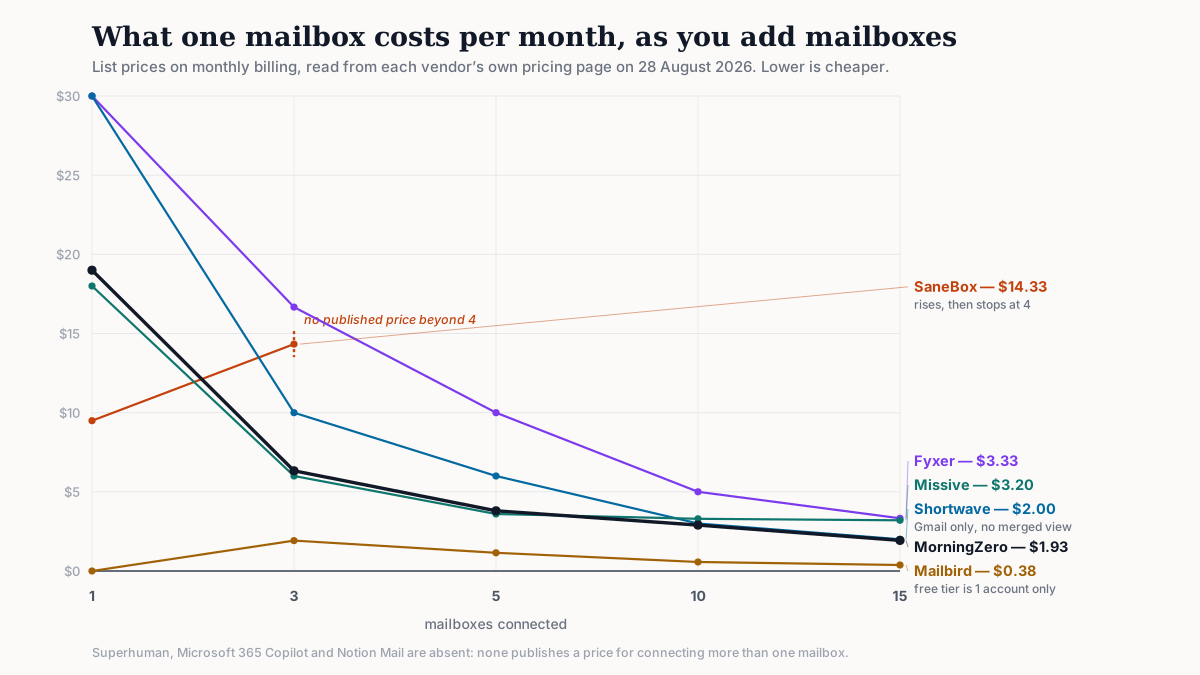
What one mailbox costs per month
Monthly billing, US dollars, list prices read on 28 August 2026. “n/a” means the vendor publishes no price for that many mailboxes — not that it is expensive, but that the number does not exist on their site.
| App | 1 | 3 | 5 | 10 | 15 | AI triage | One merged view? |
|---|---|---|---|---|---|---|---|
| Thunderbird | $0.00 | $0.00 | $0.00 | $0.00 | $0.00 | No | Yes |
| Apple Mail | $0.00 | $0.00 | $0.00 | $0.00 | $0.00 | Summaries only | Yes |
| BlueMail | $0.00 | $0.00 | $0.00 | $0.00 | $0.00 | Paid tiers only | Yes |
| Canary Mail | $0.00 | $0.00 | $0.00 | $0.00 | $0.00 | Paid tiers only | Yes |
| Spark | $0.00 | $0.00 | $0.00 | $0.00 | $0.00 | Paid tiers only | Yes |
| Mailbird | $0.00 | $1.92 | $1.15 | $0.57 | $0.38 | Paid tiers only | Yes |
| MorningZero | $19.00 | $6.33 | $3.80 | $2.90 | $1.93 | Yes, all accounts | Yes |
| Missive | $18.00 | $6.00 | $3.60 | $3.30 | $3.20 | Paid, credits or BYOK | Yes |
| Shortwave | $30.00 | $10.00 | $6.00 | $3.00 | $2.00 | Yes, Gmail only | No |
| Fyxer | $30.00 | $16.67 | $10.00 | $5.00 | $3.33 | Yes | Works inside Gmail/Outlook |
| SaneBox | $9.49 | $14.33 | n/a | n/a | n/a | Filtering, not LLM triage | No |
| Superhuman | $30.00 | n/a | n/a | n/a | n/a | Yes | Per account |
| Microsoft 365 Copilot | $30.00 | n/a | n/a | n/a | n/a | Yes, one identity | No |
| Notion Mail | $0.00 | n/a | n/a | n/a | n/a | Yes, Gmail only | No |
How we worked it out
The method is boring on purpose, so you can redo it and catch us if a price has moved.
A mailbox means one email account you receive mail into. For each app we took the cheapest published plan that legitimately covers that many mailboxes, on monthly billing, then divided the monthly total by the number of mailboxes. Where a plan includes a set number and sells extras — MorningZero at $3 a mailbox, Missive at $15 per five shared accounts — the extras are added before dividing. Annual billing is cheaper almost everywhere and we note it in the sources, but monthly is the only basis every vendor offers, so monthly is what the table compares.
Where a vendor does not publish an account limit, we did not invent one. Superhuman lists $30 a member a month and says nothing anywhere on its pricing page about how many mailboxes a member may connect, so its row stops at one. That is a reporting gap, not a product verdict.
Why the same headline price produces an 8.7x spread
At five mailboxes, the cheapest paid option is Mailbird Premium at $1.15 a mailbox and the dearest is Fyxer Professional at $10.00. Both look like ordinary mid-priced software on their own pricing pages. The gap opens up because of a structural choice buried under the price.
Per-licence products let one subscription cover any number of accounts. Mailbird Premium lists $5.75 a month and its comparison table reads “Email accounts per device: Free 1, Premium Unlimited” — so the fifth mailbox is free and the fifteenth costs 38 cents. Per-seat and per-account products charge again for each one. SaneBox is the clearest case in the set and the only line on our chart that rises: Snack covers one account at $9.49, Lunch covers two at $15.99, and Dinner covers four at $42.99. Three accounts means buying Dinner, so the per-mailbox cost goes up from $9.49 to $14.33 as you add your second and third.
This is the thing to check before the headline number. A $30 product that connects unlimited accounts is cheaper at five mailboxes than a $10 product that connects one.
Four apps that cannot price five mailboxes
This was the surprise. A quarter of the products we looked at have no published answer to “what does this cost for five accounts”.
SaneBox stops at four. Its FAQ handles the rest by hand: “Can I connect more than 4 email accounts to SaneBox? You sure can. Contact us and we’ll be happy to help.” Perfectly reasonable, but it means no price exists for five.
Superhuman and Microsoft 365 Copilot both publish clean per-seat pricing — $30 a member a month and $30 a user a month respectively — and neither states what a seat covers in mailbox terms. Copilot is licensed against one Microsoft 365 identity; whether its Outlook features reach a second connected account is not addressed on any pricing page we could find.
Notion Mail is free, Gmail-only, and explicit that “Only one email address can be tied to a Notion Mail account.” You add a second address by creating a second Notion Mail account. It is also, as of the help page today, on a countdown: “Notion Mail is shutting down on September 22, 2026.” If you are choosing a multi-account app in the next month, that is the whole review.
Shortwave prices well and then tells you to use forwarding
Shortwave’s per-mailbox economics look strong — $30 a seat, paid features shared across every signed-in account, so $2.00 a mailbox at fifteen. The catch is not in the price. It is in the docs.
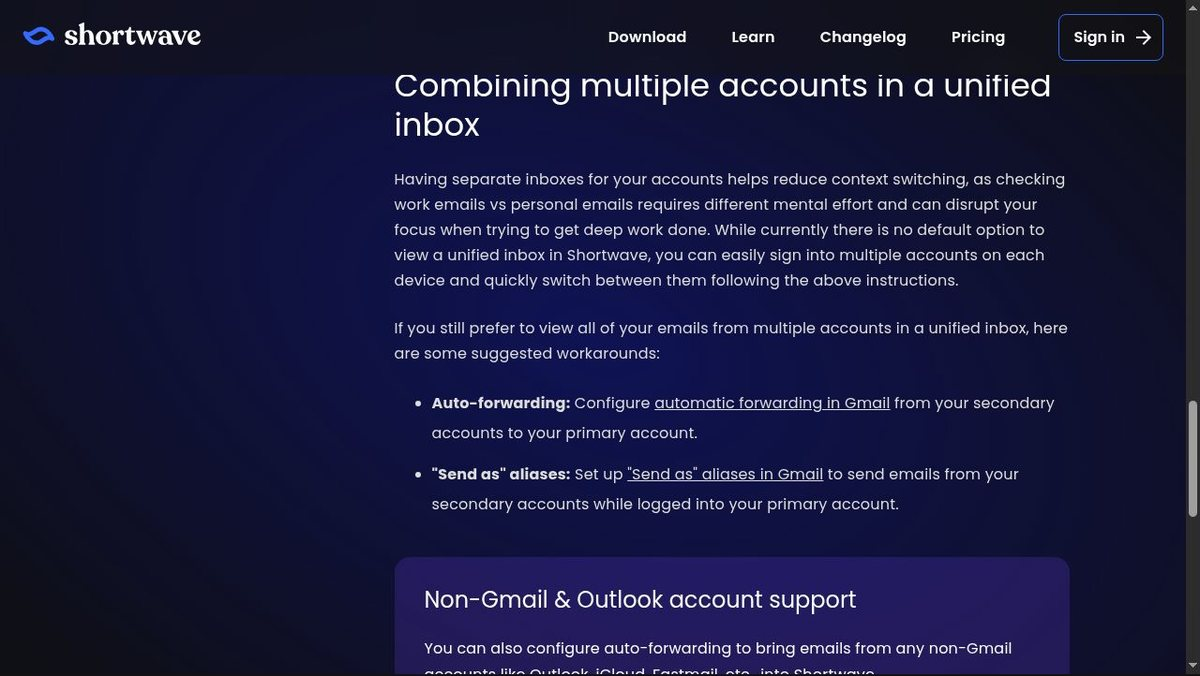
Shortwave’s multi-account documentation, captured 28 August 2026. Source: shortwave.com/docs/how-tos/multi-account
In its own words: “While currently there is no default option to view a unified inbox in Shortwave, you can easily sign into multiple accounts on each device and quickly switch between them.” For anyone who does want one stream, it suggests two workarounds — configure auto-forwarding in Gmail from your secondary accounts, or set up “Send as” aliases.
Credit where it is due for publishing that plainly. But it reframes the price. You are buying fast account switching, not a merged inbox, and non-Gmail addresses arrive by forwarding because Shortwave requires a Gmail or Workspace account to sign in at all. If you want to understand why forwarding is a workaround rather than a solution, we went through the reply-identity problems it creates in our guide to managing multiple email accounts.
The free apps are genuinely free, and that matters
Five apps in the table put every account you own into one view for nothing: Thunderbird, Apple Mail, BlueMail’s Personal plan, Canary Mail’s free plan and Spark’s free tier. Canary’s free tier lists unlimited mail accounts, capped at two devices. Thunderbird is open source and takes donations.
Anyone selling you a paid multi-account inbox should say this out loud, so: if all you need is several mailboxes in one list, you do not need to pay anyone, and the $0.00 rows in that table are real. We are not going to pretend otherwise to make our own row look better.
What none of them do is read across those accounts and decide what matters. That is the line between a merged view and triage, and it is the only thing the paid tier is actually selling. Whether it is worth $2 or $10 a mailbox depends entirely on how much mail you are drowning in — which is a question about your week, not about the software.
Where MorningZero lands, honestly
Third cheapest at five mailboxes among the paid options, at $3.80. Mailbird and Missive both come in under us there. At fifteen mailboxes we are $1.93 and only Mailbird is cheaper.
The reason our line falls the way it does is the pricing shape rather than any generosity: Solo is $19 a month for five mailboxes, Stack is $29 for fifteen, and extra mailboxes are $3 each with no cap. Billed annually the plans are $180 and $276, about $15 and $23 a month. Nothing is metered — no credits, no request quotas, no message limits — and the triage runs on every connected account rather than a selected one. We support Gmail, Google Workspace, Outlook.com and Microsoft 365 through their consent flows, plus hosted IMAP for Fastmail, iCloud, Yahoo, AOL, GMX, Web.de, Zoho, Yandex and Mail.com using an app password.
Where we lose: Mailbird is cheaper per mailbox at every count above one, and if you are on Windows and want a tidy unified client rather than AI triage, that is the better buy. Custom or self-hosted IMAP servers are not supported. Proton needs Bridge running on your own machine, so it is out. No iPhone app yet; MorningZero runs on the web, macOS, Windows, Linux and Android. And there is no free tier; there is a 14-day trial that needs no card, with every feature on across five mailboxes.
For a wider view of what each AI email tool is actually best at, rather than what it costs, see the ten best AI email assistants. For the metering question — which tools ration AI requests and which do not — that is in our head-to-head comparisons. And if the term itself is doing heavy lifting here, what a unified inbox actually is defines it properly. The category is wider than mail clients, though: eleven email productivity tools tested across several mailboxes puts the cleanup services and add-ons through the same cross-account test, and six of the eleven fail it.
Use the data
The full dataset — every product, all five mailbox counts, the plan chosen at each count, the account limit, the provider list and the source URL — is available as a CSV under a plain attribution request: if you quote a figure, link back and carry the check date with it, because these numbers decay.
We will re-verify every cell quarterly. If you find one that has already moved, tell us and we will correct it with a fresh date rather than quietly editing the number.
If you want to see what unmetered triage across five mailboxes feels like on your own mail rather than in a table, MorningZero is here — though the honest read on the table above is that plenty of people reading this should just install Thunderbird.
Sources
Every price and account limit read from the vendor’s own page on 28 August 2026:
- MorningZero pricing — Solo $19/5 mailboxes, Stack $29/15, extras $3 with no cap, annual $180 and $276
- Shortwave pricing — Business $30/seat, Premier $45, Max $120 — and multi-account docs for the unified-inbox statement
- Superhuman pricing — Starter $30/member monthly, $25 annual; Business $40 monthly, $33 annual; no account limit published
- Missive billing docs — Starter $18/user monthly ($14 annual), Productive $30 ($24), Business $45 ($36), five shared accounts per user, extras $15 per five
- Spark pricing — Free $0 with unlimited accounts, Plus $10/user monthly, Pro $20
- Mailbird pricing — Free $0 limited to one account per device, Premium $5.75 a month with unlimited accounts. Note that Mailbird publishes no monthly billing option: on 5 September 2026 the page offered Premium only as $4.03 a month paid yearly or $99.75 once, against a $5.75 and $399 list. Its row is the least comparable in the table for that reason
- Canary Mail pricing — Free $0, Growth $36/year, Pro+ $100/year, yearly or lifetime only, unlimited mail accounts on every tier
- Fyxer pricing — Starter $30 monthly ($22.50 annual) for one inbox, Professional $50 ($37.50) for multiple
- SaneBox pricing — Snack $9.49 monthly for one account, Lunch $15.99 for two, Dinner $42.99 for four
- BlueMail pricing — Personal free with unlimited accounts
- Thunderbird — free and open source, no account cap
- Apple Mail — bundled with macOS and iOS; iCloud+ buys storage, not the Mail app
- Microsoft 365 Copilot pricing — $30/user/month paid yearly
- Notion Mail help — free, Gmail only, one address per account, shutting down 22 September 2026
Frequently asked
What is the best email app for multiple accounts?
If you only need several accounts in one view and no AI, Thunderbird, Apple Mail, BlueMail and Spark all do it for $0 with no account limit. If you want AI that sorts every account, the published monthly cost per mailbox at five accounts runs from $1.15 with Mailbird Premium to $10.00 with Fyxer Professional, checked 28 August 2026.
How much does an email app cost per mailbox?
It depends entirely on whether the vendor charges per seat or per licence. Across the 14 apps we priced on 28 August 2026, the cost of one mailbox at five connected accounts ranged from $0.00 to $10.00 a month. Products that allow unlimited accounts on one subscription get cheaper with every mailbox you add; products that bill per account get more expensive.
Which email apps have no published price for five mailboxes?
Four of the fourteen. SaneBox publishes tiers up to four accounts and then asks you to contact them. Superhuman and Microsoft 365 Copilot publish per-seat prices without stating how many mailboxes a seat covers. Notion Mail ties one email address to one account, and is shutting down on 22 September 2026.
Does Shortwave have a unified inbox?
No. Shortwave's own documentation states there is no default option to view a unified inbox, and suggests Gmail auto-forwarding or 'Send as' aliases as workarounds. Shortwave also requires a Gmail or Google Workspace account to sign in, so other providers reach it by forwarding.
Is there a free email app for multiple accounts?
Yes, several. Thunderbird is free and open source with no account cap. Apple Mail is bundled with macOS and iOS. BlueMail's Personal plan and Canary Mail's free plan both list unlimited email accounts, and Spark's free tier does too. What you give up at $0 is AI triage that reads across all of those accounts.
Is it cheaper to pay per mailbox or per seat?
Per mailbox, once you pass two or three accounts. A per-seat product charges roughly the same whether you connect one mailbox or five, so the per-mailbox cost only falls if the vendor lets one paid seat cover several accounts. Check the account limit before the headline price — it moves the real cost far more.