
Clean up Gmail, Outlook and the rest in one pass: Sweeps
Years of clutter come from a short list of senders. Sweeps finds them across every mailbox and lets you deal with the list instead of the messages.
Facts and prices checked 26 September 2026
Everyone knows their inbox is full of newsletters. The shape of it is the surprise.
We measured ours in August. Of all the machine-generated mail, ten senders produced 43 percent. 94 percent of bulk mail was never opened.
We measured again on 20 September. 44.9 percent of everything received in the previous ninety days carried an unsubscribe header. Half of the inbox is mail someone offered to stop sending.
That concentration is the design of Sweeps. Ten senders are 43 percent of the noise, so ten decisions clear 43 percent of it.
Who sent the machine-generated mail
94%of bulk mail never opened
Same August sample.
44.9%carried an unsubscribe header
Ninety days to 20 September 2026.
What you see
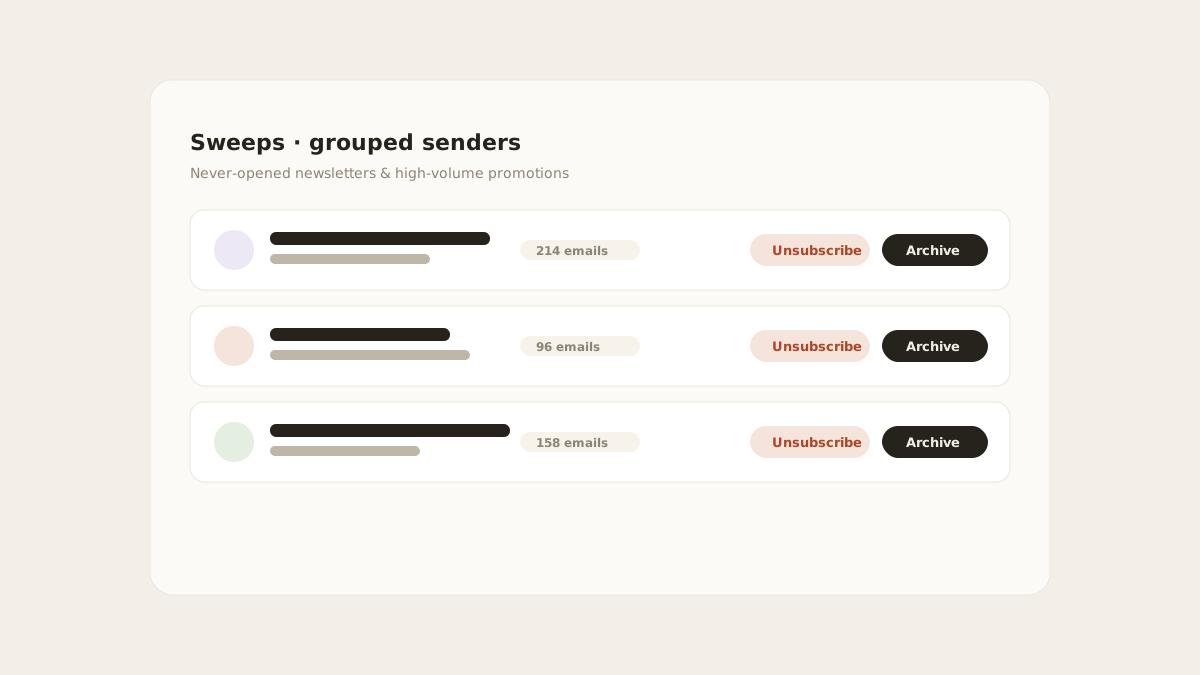
Open Cleanup and the mail is already grouped by sender, across every connected inbox, ordered by volume. Two numbers per row: how many messages, and how many you opened.
Two switches do most of the work. Never opened leaves only the senders you never read. Has unsubscribe leaves the ones that can be stopped with one request. A months control sets how far back it looks.
Each row offers unsubscribe, and archive or trash. One button, Unsubscribe all, takes every never-opened sender that has a link, unsubscribes from each, and archives their mail in a single pass.
How unsubscribe works
Bulk senders are supposed to include a List-Unsubscribe header, and most do.
We send the one-click request the RFC 8058 way, from our side, to the sender's unsubscribe link. If the sender doesn't accept that, we make a plain request to the same link. Either way, no landing page, no survey.
Some senders offer only a mailto address, or nothing at all. Those rows are marked, and muting the sender is the fallback.
Tokens in unsubscribe links are treated as secrets. They're never logged.
Unsubscribe, archive, or trash
| Action | What it does | Use it when |
|---|---|---|
| Unsubscribe | Stops future mail from the sender | You never want this sender again |
| Archive | Removes existing mail from the inbox, keeps it searchable | You want a clean inbox but might need the history |
| Trash | Removes mail on your provider's schedule | You're certain |
The combination worth reaching for is unsubscribe plus archive: the flow stops, the backlog leaves the inbox, and nothing is destroyed.
A routine that holds
Run Sweeps once a month. The list is already ordered by volume, so decide about the top ten.
In our August data that one pass would have removed 43 percent of the machine-generated mail.
Anything you're unsure about can wait. If you never open it, that sender is at the top of Never opened next month.
What it costs
Nothing per message on a paid plan.
During the trial each message archived or trashed by a sweep draws one unit from the trial's fixed allowance. The trial has no card behind it, and a bulk archive of ten thousand messages is what that allowance exists to bound. Unsubscribing itself is free everywhere.
What it won’t do
The limits, before you find them yourself.
It can't unsubscribe from a sender that offers no working unsubscribe. With no List-Unsubscribe link, the row is marked and you mute the sender or deal with it by hand.
It won't decide for you that a subscription is unwanted. It groups and proposes. You act.
It doesn't keep receipts and calendar mail out of the list. A sender that mails you both a newsletter and invoices is one row, so read the counts before you archive it.
Trash follows your provider's own emptying schedule. We won't undo that for you.
Questions
Asked often enough to answer here.
How does one-click unsubscribe work?
Bulk senders include a List-Unsubscribe header with a link. We send the one-click request (RFC 8058) to that link ourselves; if the sender doesn't accept it, we make a plain request to the same link. No landing page for you to click through.
How much of my email can be unsubscribed from?
Across the mailboxes on MorningZero, 44.9 percent of the mail received in the ninety days to 20 September 2026 carried an unsubscribe header.
Does archiving delete anything?
No. Archived mail leaves the inbox and stays searchable. Trash is separate and permanent on your provider's schedule.
Does it work across all my accounts at once?
Yes. Sender groups are built across every connected mailbox. A newsletter that reaches two of your addresses shows as one decision.
Nothing sends itself
See it on your own mail.
Fourteen days, up to five mailboxes, no card. Connect the two you check most and watch the first morning sort itself.